A Spring Walk Through a UK Fen: What to See and How to Read the Landscape
The first thing a fen does in spring is announce its water. Ditches fill, the peat softens underfoot, and every tussock carries a shine. Walk the same path in February and again in August and you pass through three quite different places. A fen is a peatland fed by mineral-rich groundwater rather than rain, which is why its water table sits close to the surface all year and why the plants and birds here are so particular. Take a slow circuit in April or May and the season reads in layers: water first, then plants, then birds.
Read the water before you look at anything else
Fen water leaves marks. Learn those marks and you can date the season more accurately than the calendar. In early spring, the winter recharge is still working through the peat, so levels are near their highest and the edges of dykes sit wet where they will be dry by June.
- Marl crusts. A pale, chalky film on stems, submerged twigs and dyke walls means calcium carbonate is precipitating out of the water. It is one of the clearest signs of a base-rich fen.
- Ochre flushes. Rusty orange streaks in a ditch often mark iron-rich water. Handsome, but frequently a sign of drainage or disturbed peat rather than a healthy system.
- Tide lines. Reed stems, sedge tussocks and wooden posts hold a stained band. That band shows you how high the water has recently stood, and how far it has dropped since.
- Bacterial sheen. A thin film on standing water may look like oil. Poke it with a stick: if it fractures into platelets and drifts apart, it is iron bacteria. A petrochemical film flows back together.
If the site has a fixed gauge post, note the level. If it does not, photograph the same tussock each visit with your boot in shot for scale — a crude measure that becomes surprisingly useful across a spring.
What comes up, and in what order
Beginners look for flowers; better observers look for sequence. Fen plants emerge in a reliable order, and once you know it you can tell roughly what week you are in.
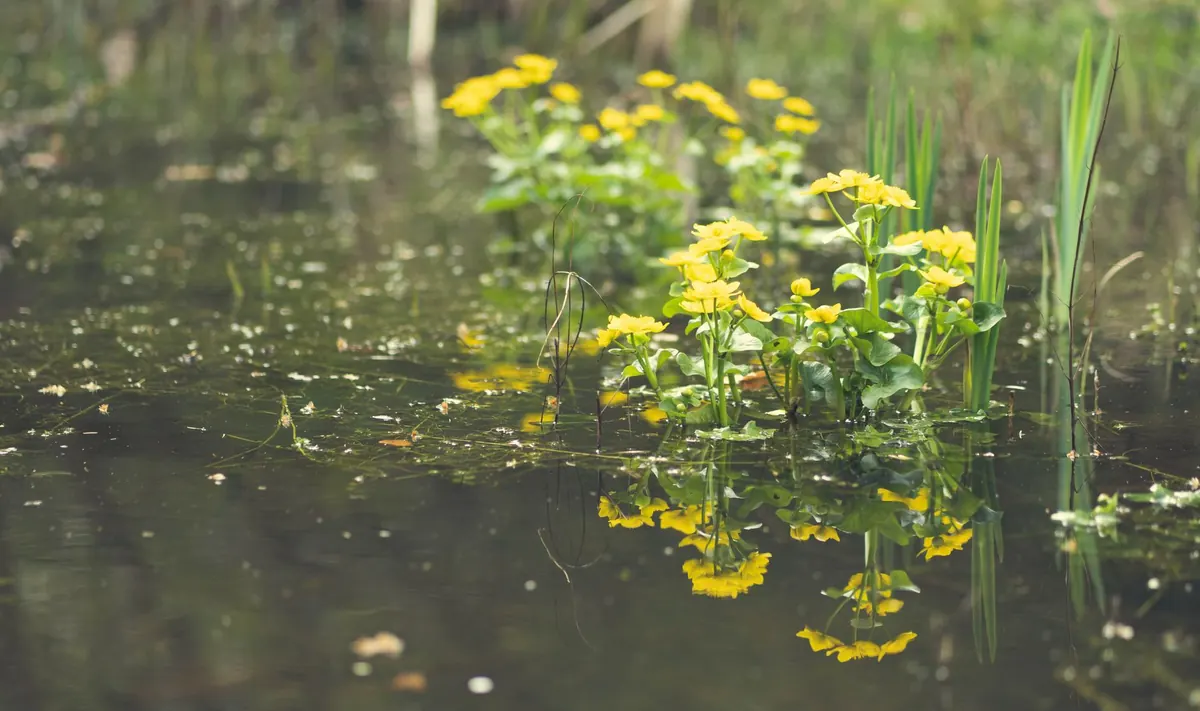
Marsh marigold, the kingcup, is usually the opening act — big butter-yellow cups over dark green leaves, often along the wettest hollows. Cuckooflower follows on slightly drier ground, soft lilac and beloved of orange-tip butterflies. Ragged robin and meadowsweet arrive later, and by late May the fen is filling out with valerian, wild angelica and the first orchids.
The sedges matter more than the flowers. Greater pond-sedge and lesser pond-sedge green up early, followed by the sharp-edged saw sedge that gives some fens their cut-throat reputation. Reed sweet-grass sweetens the air when crushed. Common reed pushes up as stiff green spears, and here is a useful reading: dense, uniform reed with little beneath it often means the ground has dried or been enriched. Patchy reed with sedges, mosses and open water between the stems is usually a fen in better condition.
Leave the rare plants alone. Many fens hold species that took decades to establish, and on reserves and designated sites collecting is against the rules. Kneel, photograph, move on.
Breeding birds: listen first, look second
Spring in a reedbed is a soundscape before it is a sight. Stand still for ten minutes at first light and let the layers arrive.
A bittern booming is a low, breathy note like someone blowing across a bottle; it carries further than you expect. Bearded tits ping to each other as they flit low across the reeds. Cetti's warbler explodes into song from cover and then falls silent. Sedge and reed warblers scratch and chatter from the edges, and reed buntings tick from the tops of stems. Above it all, a marsh harrier may sky-dance, dropping and twisting, or pass food to a mate in mid-air.
On the wet grassland beside the reeds, spring means waders. Lapwings tumbling over the fields, redshank calling from a post, snipe drumming with their tail feathers in a steep dive. These are the birds most easily disturbed, and a dog off the lead in April can put a lapwing off a nest that then chills. Keep to paths, keep dogs on leads, and use a hide if there is one.
Binoculars are useful; patience is more useful. Most fen birds give themselves away by sound long before they show themselves.
Small things that tell a bigger story
Look into the water as well as across it. Calcium-rich fens support snails with heavy shells, caddis larvae in cases built from plant fragments, and freshwater shrimp in the dykes. Ramshorn snails and pea mussels are good indicators of the water's chemistry, and the shells you find in the peat show what lived here before.
On the surface, water crowfoot flowers in the clearer dykes and water violet sends up its pale lilac spikes. Both dislike muddy, nutrient-heavy water, so their absence is as informative as their presence. Dragonflies and damselflies come later in spring; a hairy dragonfly on the wing in May is a sign the dyke system is working.
Reading the management on the ground
A healthy fen is patchy. You should find open water, low sedge, tall reed, scattered scrub and a few trees, and you should be able to see the joins between them. That variation is usually the result of deliberate work: winter grazing by cattle, mowing on a rotation, scrub cut back before it takes hold.
Clues to look for include nibbled sedge tips and hoof prints in the soft ground, cut stems left in rows, and older peat pits holding open water. Where a fen looks uniformly tall and dark, with willow creeping in and few herbs beneath, suspect drying or abandonment. Straight dykes, sluices and the odd brick pump house tell you the site was once drained on purpose — much of lowland England's fenland was, and what survives is often the fragments that resisted.
A practical kit list and a few rules
- Wellies or waterproof boots. Fen peat is wet long after the path looks dry.
- A paper map as well as a phone. Signal is patchy and boardwalks flood.
- Binoculars, a notebook and a hand lens for mosses and sedges.
- A stick for testing depth and sheen, and a spare layer — fens are cold in a wind.
- Water and a snack; there is rarely anywhere to buy anything nearby.
Stick to boardwalks and marked paths, do not step on tussocks, do not use recorded bird calls to draw birds in, and leave drones at home. If you find something unusual, photograph it with a scale and note the grid reference rather than picking it.
Make the walk count
One visit tells you very little; three visits over six weeks tell you a great deal. Walk the same route in early April, late April and mid-May, and note the water level, the first flowers, and which birds are singing. Add the date to every photograph.
Then send the records somewhere useful. Local environmental records centres and national recording schemes welcome sightings, including common ones, and reserve wardens are often short of records for mosses, sedges and invertebrates. Ask what they would like noted. A walk with a notebook in your pocket is a walk twice as long, and the fen rewards that kind of attention.
Photo: Couleur / Pixabay