A Beginner's Guide to Identifying Common UK Marsh Plants
Marshes are generous places. A few metres of wet ditch, a spring flush in the corner of a field, the soggy strip beside a river — any of these can hold half a dozen plant species stacked shoulder to shoulder, all competing for the same saturated ground. The trouble for a beginner is that so much of it reads as green, upright and grassy at first glance. Learn four plants properly, though, and the marsh starts to organise itself. Reedmace, purple loosestrife, marsh marigold and the sedges between them cover a great deal of what you are likely to meet, and each one teaches a skill you will use on everything else.
Let the habitat make your shortlist
Before you look at a single leaf, work out what you are standing on. Marsh plants are often fussy about how wet the ground is and how rich it is in minerals, and that alone rules out a lot of wrong answers.
- Open water margins that draw down in summer: reedmace, bur-reeds, water plantain.
- Wet hollows and flushes fed by groundwater: marsh marigold, opposite-leaved golden-saxifrage, sedges.
- Tall, rank fen with shoulder-high growth: purple loosestrife, meadowsweet, greater tussock-sedge.
- Grazed wet pasture with short tussocks: star sedge, carnation sedge, marsh lousewort.
Is the water moving or still? Is there peat underfoot or grey silt? Make a note of it. A wet meadow list looks very different from a ditch-side one, and knowing which you are in saves a lot of squinting at leaves.
Reedmace: the one everyone knows by sight
Great reedmace (Typha latifolia) is the fat brown poker that generations of children have called a bulrush. The name properly belongs to a sedge, but almost nobody uses it that way. Four marks will settle an identification:
- Flower spike: a dense brown cylinder of female flowers with a paler, dustier male spike directly above it.
- Leaves: long grey-green straps, flat with one face slightly hollowed, spongy in cross-section, often as tall as you are.
- Stem: stout, round and unbranched, with the whole plant growing in a fan from a creeping rhizome.
- Season: spikes form in June and July, then turn woolly and burst into down in late autumn and winter.
Telling it from lesser reedmace
Lesser reedmace (Typha angustifolia) is the slimmer relative. Its leaves are narrower — usually under a centimetre across — and there is a clear stretch of bare stem between the male and female spikes. On great reedmace the two spikes touch. Hybrids do occur and can be intermediate, so treat the gap as a strong hint rather than an absolute rule. If the plant is growing in deep water with leaves as wide as two fingers, you are almost certainly looking at great reedmace.
Purple loosestrife: tall spikes of magenta
In July and August, purple loosestrife (Lythrum salicaria) is hard to miss. It reaches head height in good fen, carrying long spikes of magenta flowers that look as though someone crumpled them in one hand and pressed them onto the stem. Start with the stem: it is angled or ridged, often flushed red near the base. The leaves are opposite or in whorls of three, lance-shaped, stalkless, and they clasp the stem in pairs that form a cross. Each flower has six petals, held in tight whorls up the spike.
Most confusion is with rosebay willowherb, which also grows tall with pink-purple flower spikes. Willowherb flowers have four petals, frequently notched at the tip, and its leaves are alternate and narrow with a distinctive pattern of veins sweeping towards the tip. Willowherb prefers dry, disturbed ground; loosestrife wants its feet in water. If you are standing in a marsh and the flowers have six petals, you have the right plant.
Marsh marigold: the first gold of spring
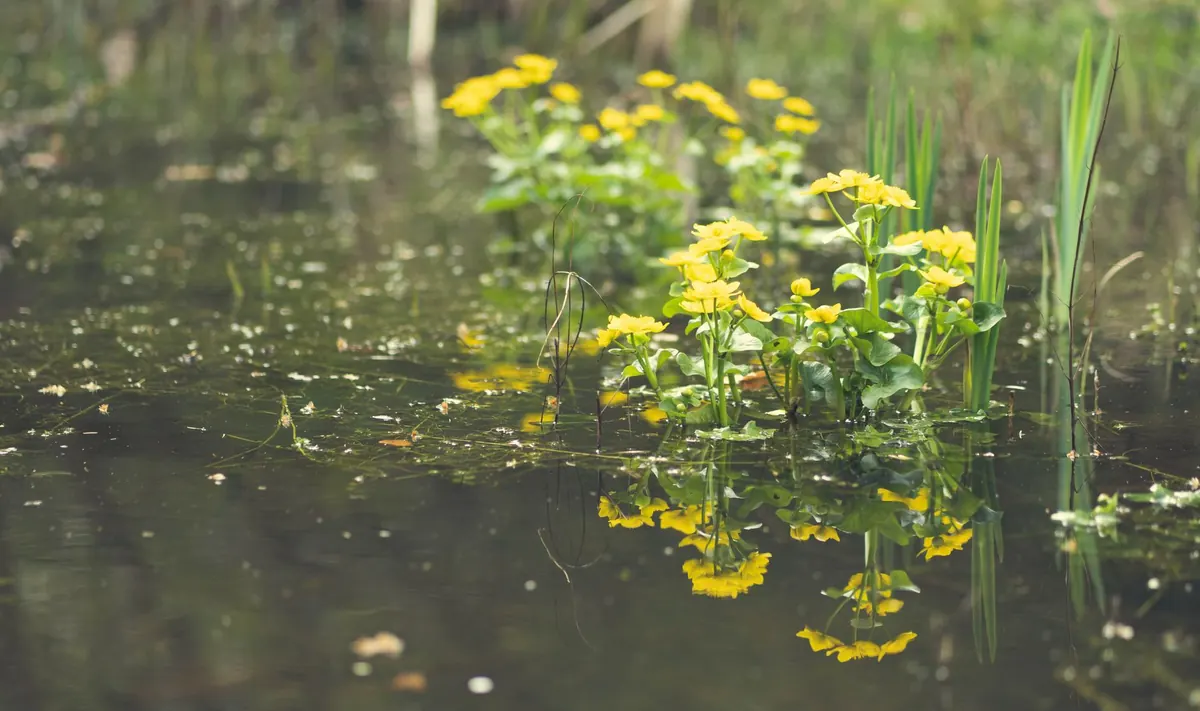
Marsh marigold (Caltha palustris) is the marsh's opening event. Glossy golden flowers appear from March into June in wet hollows, alder carr and along stream edges. Each flower is roughly 2–4 cm across and looks like an oversized buttercup, but the yellow parts are sepals rather than petals and the centre is a dense boss of stamens. The leaves give it away: dark green, hairless, shiny, kidney- or heart-shaped with wavy edges, usually about the size of your palm. Plants grow in loose clumps, not as single stems.
Two lookalikes are worth knowing. Lesser celandine flowers earlier in drier, shadier spots, with smaller, starrier flowers and leaves often blotched with pale markings. Lesser spearwort is another yellow wetland relative, but its flowers are smaller and paler on slender stalks, and its leaves are narrow rather than rounded.
Sedges: edges, triangles and the three-way test
Sedges reward patience. There are many species, and beginners often give up at the genus stage, which is a shame because the group is straightforward once you have the habit.
Sedges have edges, rushes are round, grasses have joints all the way down.
Roll a stem between finger and thumb. A sedge's triangular stem rolls smoothly; a rush stays stubbornly round and solid. Then find the female flowers. In sedges these sit inside little bottle-shaped sacs, packed into spikes — a feature no grass or rush shares. With a hand lens those sacs will even separate species.
- Greater tussock-sedge (Carex paniculata): builds big, pale, pedestal-like tussocks in fen.
- Greater pond-sedge (Carex riparia): tall, broad grey-green leaves and thick female spikes that droop as they ripen.
- Star sedge (Carex echinata): small, neat, with starry spikes, common in grazed wet pasture.
- Yellow sedge (Carex flava): yellow-green, with long-beaked sacs in compact heads.
A simple routine that works
- Note the wetness: standing water, flushed ground, damp meadow or ditch bank.
- Check the stem in cross-section. Round, angled or triangular?
- Look at leaves: opposite or alternate, clasping or stalks, hairy or smooth, flat or folded.
- Count the flower parts and note how they are arranged.
- Record the date. Timing eliminates more mistakes than any other single detail.
- Photograph the whole plant, the stem, a leaf and a close-up of the flowers, with something for scale.
Marsh manners and keeping safe
Wet ground hides things: deep ditches, soft patches, old drainage grips. Go with someone, wear wellingtons, and tell a friend where you are heading. Stay on boardwalks and paths in nature reserves, and check access rules before you set off — many marshes are protected sites where plants must not be picked or trampled. The Countryside Code applies wherever you are: leave gates as you find them, keep dogs under control near breeding birds, and take nothing but photographs. Never taste a wild
Photo: MabelAmber / Pixabay